
5. Implementing the Response Plan in the Moment
Now that we have discussed the importance of putting a written response plan in place and practicing the plan, we turn to implementing the plan. This section addresses what happens when ICE agents appear at your premises and request access to private areas and/or organization records.
Please note that we do not provide this guidance as a series of “steps” to follow, as your organization’s response to an ICE interaction will happen in the moment.
Staff/Volunteers
- Immediately contact your organization’s Designated Response Person. Stay calm and professional. Refer to your organization’s Response Plan and follow it.
- Advise ICE agents that staff members/volunteers do not have the authority to consent to law enforcement’s entry into any non-public areas of the facility, and that someone who does have this authority is being contacted and will arrive ASAP.
- If enforcement agents claim to have and/or present a warrant:
- ask for a copy of the warrant
- take a photo or make a scan of the warrant and send it to the Designated Response Person immediately
- Ask agents to wait in a designated waiting area (which should be a public space like a waiting room or outside of your office) until the organization’s Designated Response Person arrives at the site.
- Document the time and date of the agents’ arrival and any additional information provided by the agents (such as names, badge numbers, statements made, actions taken).
- Staff/volunteers are not required to provide information about your organization’s programs or persons your organization serves and should not answer questions from ICE agents without direction from the Designated Response Person and/or legal counsel. If questioned directly, they can state that they are not authorized to answer or provide information.
- Staff members/volunteers can used prepared cards with scripts – these can be read and/or can be handed over to ICE agents. For example, “I am a staff member/volunteer of this organization. I am not authorized to answer questions or provide any information to you. I have contacted our organization’s Designated Response Person, who is authorized by our organization to communicate with you. Thank you.”
- Staff/volunteers should be especially wary of statements that may be used by agents to gain access to a non-public area, and that they may try to do so without a warrant. Agents may say things like “can you help us identify this person?”; “is [name] here?”; or “we are investigating a crime.” Remember that law enforcement needs a proper warrant in order to lawfully enter non-public spaces of your organization’s facilities.
Designated Response Person
- Upon being advised by a staff member/volunteers of an ICE agent’s entrance/request to enter your facility, the Designated Response Person should immediately:
- contact legal counsel and advise them of the agent’s presence
- send a copy of any warrant presented to legal counsel to confirm validity/legitimacy
- go to the site immediately, if they are not already there.
- Obtain the name and contact information and business card for the lead government agent, let the lead government agent know that the organization’s legal counsel has been contacted, and put legal counsel in touch with the lead government agent, so that counsel can communicate directly with the lead agent.
- Review any warrant presented to ensure (i) it is signed by a judge or magistrate; (ii) it describes your facility as the place to be searched; (iii) it has the correct date and was issued within the past 14 days (for ICE warrants); and (iv) the proposed search does not exceed the scope of items authorized in the warrant.
- This review is not intended to take the place of review by legal counsel.
- Inform the lead government agent that your organization is not consenting to the search until your organization’s legal counsel has an opportunity to assess the warrant’s sufficiency and advise on appropriate next steps.
- If a government agent asserts or declares the existence of an exigent circumstance and demands immediate access, your organization’s Designated Response Person may request additional information but should comply with the request and immediately notify legal counsel of the government agent’s assertion/declaration.
What to Watch! Judicial vs. Administrative Warrants
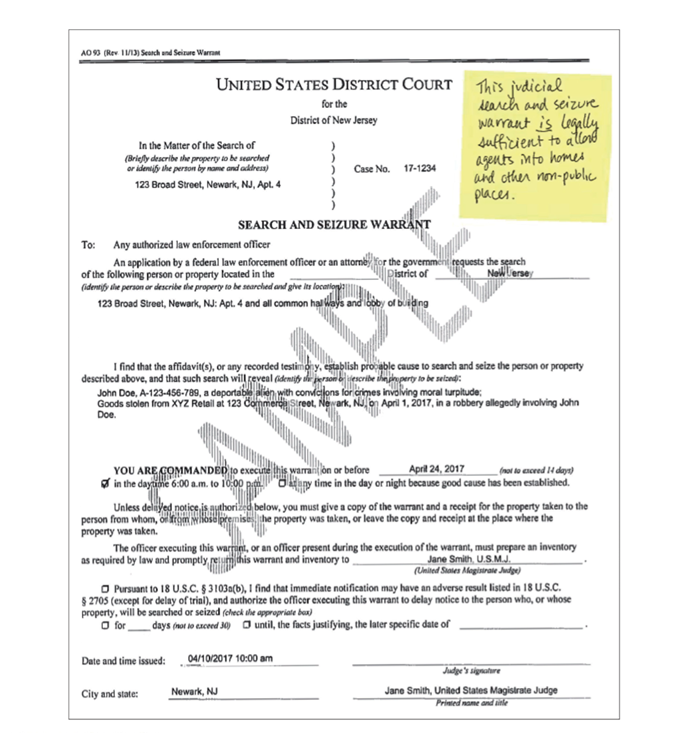
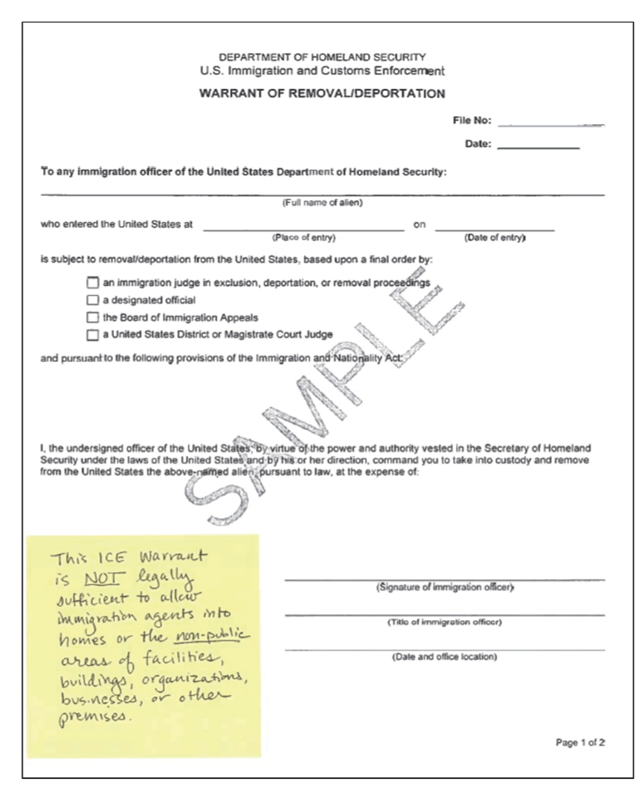
- There is an important difference between a judicial search or arrest warrant and an administrative or ICE warrant (see examples of each below).
- Entry into private areas of your organization’s premises is permissible only with a court-issued (judicial) warrant that meets very specific qualifications: (i) signed by judge or magistrate; (ii) describes your facility as the place to be searched; (iii) has the correct date and was issued within the past 14 days; and (iv) the proposed search by agents does not exceed the scope of items authorized in the warrant.
- If immigration agents have a judicial warrant, your organization must provide access to the specific areas and documents identified in the warrant (your organization need not provide access to any others).
- An administrative or ICE warrant is not sufficient to require admittance for ICE agents. For example, an ICE Warrant for Arrest of Alien (Form I-200) is a warrant often used by ICE agents, but it is not a judicially issued warrant and does not authorize entry into private areas of your facility.
- The key is whether it’s court-approved and has the other requisite details.
Important!
The Department of Homeland Security (DHS) issued a memorandum in May 2025 (made public in January 2026) providing that administrative warrants do provide ICE agents access to private areas, which is still in effect.
The following are examples of a judicial warrant and an administrative warrant.
Interference with Agent Activity
- Staff and/or volunteers may not interfere with or impede the actions of ICE agents and must remain a reasonable distance away from the agents at all times.
Recording and Other Rights
- Anyone present may record or take a video of any interactions with ICE agents or of agent activity, even prior to submission of a warrant, but must clearly and audibly announce they are doing so in order to put all parties on notice they are being recorded.
- Such statement should be made as soon as the recording/video begins, to provide documentation that this statement was made.
- For safety reasons, anyone recording or taking video of the interaction should keep their camera/phone in plain sight and not conceal the fact that they are recording.
- Anyone recording and/or taking a video must remain a reasonable distance away from agents so as to not interfere with their actions and/or put themself in harm’s way.
- Your organization’s Designated Response Person may inform staff, volunteers, and/or persons served by the organization who may be questioned by ICE agents that they are permitted to ask the agents if they are free to leave. If an individual is advised by the agents that they are not free to leave, the Designated Response Person may inform such person that they have the right to consult legal counsel and have the right to remain silent.
Important Note: While your organization may advise persons of their right to remain silent, your organization may not direct them to be silent.
- Your organization may send its staff and volunteers home and may contact staff and volunteers who are not on the premises and advise them to stay home until further notice. If doing this, it’s important that all staff and volunteers receive the same directive.
Prohibited Actions
- Your organization may not hide, impede access to, or aid someone trying to escape/hide from ICE agents and may not hide or destroy documents that ICE agents are requesting access to.
- Never provide false information to ICE as this can result in criminal penalties including fines and imprisonment.
- Never provide false “tips” to ICE regarding persons alleged to be in the United States unlawfully as this can lead to potential civil liability and defamation claims.